

C46400 – Naval Brass

Our Products
Our Brochure
C46400 – Naval Brass Brochure
Download

Descriptions
C46400 Naval Brass is a high-strength duplex (α + β) copper–zinc–tin alloy containing approximately 60% copper, 39.2% zinc, and 0.8–1.0% tin. The addition of tin significantly improves its resistance to seawater corrosion, dezincification, and stress-corrosion cracking.
Designed for demanding marine and industrial environments, Naval Brass combines superior corrosion resistance with excellent hot-working and machining characteristics. Its balanced composition ensures strength, rigidity, and formability, making it ideal for components that must endure high stress, pressure, or saltwater exposure.
Because of its outstanding durability and anti-galling properties, C46400 Brass is the preferred choice for marine hardware, pump and valve parts, propeller shafts, fasteners, and structural fittings that require both mechanical performance and long-term corrosion resistance.
Chemical Composition
C46400 Naval Brass is a copper–zinc–tin alloy engineered for high strength and superior resistance to seawater corrosion and dezincification. The controlled addition of tin enhances both mechanical integrity and long-term corrosion resistance in marine and industrial environments.
| Element | Composition (wt%) |
|---|---|
| Copper (Cu) | 59.0 – 62.0 |
| Zinc (Zn) | Balance (≈ 37 – 40) |
| Tin (Sn) | 0.50 – 1.00 (typically 0.8 – 1.0) |
| Lead (Pb) | ≤ 0.20 (trace) |
| Iron (Fe) & Others | ≤ 0.10 each |
| Total (Cu + Named Elements) | ≥ 99.6 |
Note: The addition of tin (~1%) improves resistance to saltwater corrosion, dezincification, and stress cracking, making C46400 ideal for marine and hydraulic applications.
Mechanical, Physical & Fabrication Properties
C46400 Naval Brass is a duplex (α + β) copper–zinc–tin alloy combining high strength, excellent corrosion resistance, and superior hot-working characteristics. The presence of tin enhances resistance to seawater corrosion, dezincification, and stress cracking, while maintaining good mechanical performance under pressure and load.
| Property | Typical Value / Description | Remarks |
|---|---|---|
| Microstructure | α + β (Duplex) | Higher strength and hardness than α-brasses; reduced cold ductility |
| Tensile Strength | ≈ 380 – 590 MPa | Varies with temper and product form |
| Elongation | ≈ 10 – 30 % | Higher in annealed condition |
| Corrosion Resistance | Very Good | Excellent in seawater; resistant to dezincification & stress corrosion |
| Workability | Excellent (Hot), Moderate (Cold) | Hot-forges and rolls easily; work-hardens on cold forming |
| Machinability | ≈ 30 % | Relative to free-cutting brass (C36000 = 100 %) |
| Fabrication / Joining | Soldering & Brazing: Excellent Welding: Good with care |
Suitable for precision marine hardware fabrication |
| Density | ≈ 8.41 g/cm³ | Typical for naval brass alloys |
| Melting Range | ≈ 880 – 930 °C | Depends on exact alloy composition |
Note: C46400 Naval Brass offers an excellent combination of strength, ductility, and seawater resistance, making it a preferred choice for marine and hydraulic system components.
Applications
C46400 Naval Brass is widely used in applications requiring high strength, excellent corrosion resistance, and superior performance in seawater environments. Its unique combination of mechanical strength and resistance to dezincification makes it ideal for marine, hydraulic, and industrial hardware.
- Marine Hardware & Fittings: Propeller shafts, housings, fasteners, and deck components exposed to seawater.
- Pumps & Valves: Pump shafts, casings, valve bodies, and seats for marine and industrial fluid systems.
- Heat-Transfer Equipment: Condenser and heat-exchanger tubes and plates for coastal or offshore installations.
- Heavy Forgings & Structural Parts: Used in shipbuilding, offshore, and hydraulic assemblies requiring strength and rigidity.
- Architectural & Industrial Hardware: Decorative fittings, façade components, and industrial hardware combining corrosion resistance with aesthetic appeal.
Summary: C46400 Naval Brass remains the standard material for marine, offshore, and high-performance engineering components where durability, corrosion resistance, and hot-formability are essential.
Standards & International Equivalents:
C46400 Naval Brass is standardized globally under various specifications covering its use in rods, plates, sheets, forgings, and marine hardware. These standards define chemical composition, mechanical properties, and testing requirements to ensure consistent performance in marine and industrial environments.
| Standard Organization | Designation / Specification | Description / Coverage |
|---|---|---|
| UNS | C46400 | Unified Numbering System designation for Naval Brass |
| ASTM / ASME |
ASTM B21/B21M – Naval Brass Rod, Bar & Shapes ASTM B171 – Naval Brass Plate, Sheet & Rolled Bar ASTM B124 – Forging Rod, Bar & Shapes |
Standard product specifications for naval brass in various forms |
| EN / DIN | CW712R / CuZn36Sn1 | European equivalent for Naval Brass with tin addition |
| BS | CZ112 / CZ133 | British Standard equivalents used for marine brass alloys |
| JIS | C4641 (family) | Japanese Industrial Standard equivalent for naval brass |
| Indian Standard (IS) | IS 291 (Grade I) | Naval Brass Rods & Sections for Machining — seawater-resistant brass |
Note: C46400 (CuZn36Sn1) is the most widely used marine-grade brass for shipbuilding, offshore, and hydraulic applications across ASTM, EN, and IS standards.
Common Names & International Identifiers
C46400 Naval Brass is one of the most recognized copper–zinc–tin alloys used globally for marine, architectural, and heavy engineering applications. It is known by various trade and international names depending on the region and standard.
- Trade / Common Names: Naval Brass, Tin Brass, Marine Brass
- UNS / CDA Designation: C46400 / CDA Alloy 464
- Chemical / ISO Designation: CuZn36Sn1
- European (EN) Equivalent: CW712R
- British Standard (BS): CZ112 / CZ133
- Japanese Standard (JIS): C4641
- Indian Standard (IS): IS 291 (Naval Brass Grade I)
C46400 Naval Brass is often informally referred to as "Marine Brass" or "Tin Brass" due to its composition and exceptional performance in seawater and offshore applications.
Common Product Forms & Dimensions
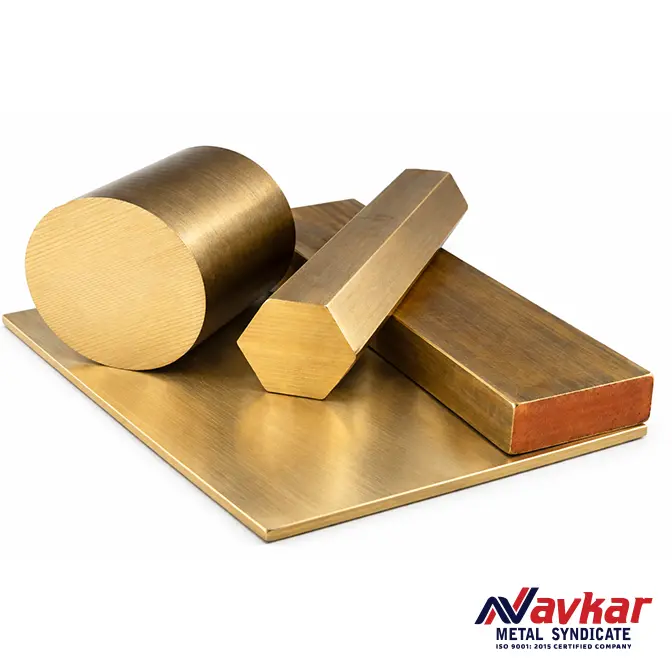
C46400 Naval Brass is supplied in a wide range of product forms suitable for marine, architectural, and industrial applications. The alloy’s excellent hot-working and machinability properties allow it to be forged, rolled, or drawn into various customized shapes and sizes as per design requirements.
| Product Form | Dimensions | Remarks |
|---|---|---|
| Rods | Ø5 mm – Ø200 mm | Available in round, hexagonal, and square profiles |
| Plates | Thickness: 0.5 mm – 50 mm Width: 100 mm – 600 mm |
Flat plates and rolled sheets for marine and industrial fabrication |
| Tubes | Outer Diameter: Ø6 mm – Ø150 mm Wall Thickness: 0.5 mm – 10 mm |
Used in condensers, heat exchangers, and fluid-transfer systems |
| Wires | Ø0.1 mm – Ø10 mm | Supplied in coiled or straight lengths for electrical and fastening applications |
| Forgings | Customized as per customer requirements | Ideal for complex marine and structural components |
Note: Special sizes, tempers, and tolerances are available upon request. Navkar Metal Syndicate supplies C46400 Naval Brass products as per ASTM, EN, and IS specifications for high-performance marine and industrial use.
Tell Us What You Need
30+
Years of Experience
Trusted Worldwide | Supplying Copper & Alloys to 1000+ clients
We usually respond within 24 working hours.