

Chromium Copper (C18200 / C18500 / CW106C)

Our Products
Our Brochure
Chromium Copper (C18200 / C18500 / CW106C) Brochure
Download

Descriptions
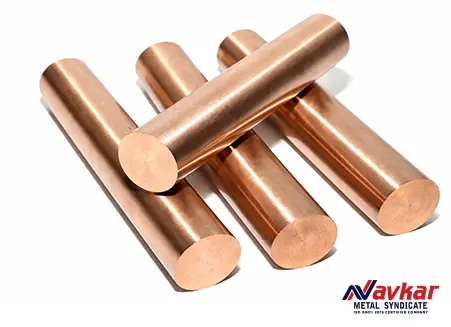
At Navkar Metal Syndicate, we supply premium Chromium Copper alloys (UNS C18200, C18500, and CW106C) engineered for exceptional electrical and thermal conductivity combined with superior strength and wear resistance. These copper–chromium alloys are precision-developed to withstand high mechanical stress and elevated temperatures, making them ideal for spot welding electrodes, electrical contacts, molds, switchgear, and resistance welding arms.
Our Chromium Copper products are precipitation-hardened through controlled heat treatment, offering a unique balance between conductivity (80–90% IACS) and hardness (up to 150–200 HB). They maintain structural stability under repeated thermal cycling, ensuring long service life and dimensional integrity in demanding applications. With excellent resistance to softening, scaling, and deformation, Chromium Copper alloys provide consistent performance in both electrical and mechanical systems.
All materials are supplied with Mill Test Certificates (EN 10204 3.1), traceable heat numbers, and export-grade packaging to support global project requirements. Whether you require rods, plates, bars, electrodes, or machined components, Navkar Metal Syndicate delivers Chromium Copper products engineered for precision, reliability, and durability.
Chemical Composition
Chromium Copper alloys are designed to deliver a superior combination of high conductivity and mechanical strength. By adding controlled amounts of chromium and, in some cases, zirconium or silver, these alloys achieve excellent performance under elevated temperature and stress conditions.
| Element | C18200 (CuCr) | C18500 (CuCrAg) | CW106C (CuCr1Zr) |
|---|---|---|---|
| Copper (Cu) | Balance | Balance | Balance |
| Chromium (Cr) | 0.6 – 1.2% | 0.6 – 1.0% | 0.6 – 1.2% |
| Zirconium (Zr) | — | — | 0.05 – 0.25% |
| Silver (Ag) | — | 0.05 – 0.12% | — |
| Impurities (Total) | ≤ 0.10% | ≤ 0.10% | ≤ 0.10% |
The minor additions of chromium, zirconium, or silver enhance the alloy’s strength and resistance to softening during thermal exposure, while maintaining 80–90% IACS conductivity. These compositions make the alloys ideal for demanding electrical, thermal, and mechanical applications.
Mechanical, Physical & Fabrication Properties
Chromium Copper alloys such as C18200, C18500, and CW106C combine excellent mechanical strength with high electrical and thermal conductivity. Through precipitation hardening and heat treatment, these alloys maintain superior wear resistance and dimensional stability even at elevated temperatures — making them ideal for demanding electrical and thermal applications.
| Property | C18200 (CuCr) | C18500 (CuCrAg) | CW106C (CuCr1Zr) |
|---|---|---|---|
| Tensile Strength (MPa) | 370 – 480 | 400 – 500 | 450 – 520 |
| Yield Strength (0.2% Proof, MPa) | 240 – 350 | 260 – 380 | 300 – 400 |
| Elongation (%) | 15 – 30 | 12 – 25 | 10 – 25 |
| Hardness (HB) | 80 – 120 | 90 – 130 | 100 – 150 |
| Electrical Conductivity (% IACS) | 80 – 90 | 75 – 85 | 75 – 85 |
| Thermal Conductivity (W/m·K) | 320 – 340 | 310 – 330 | 320 – 340 |
| Density (g/cm³) | 8.89 | 8.90 | 8.89 |
| Melting Point (°C) | 1080 – 1085 | 1080 – 1085 | 1080 – 1085 |
| Fabrication Properties |
|
||
These alloys offer a superior balance between conductivity, strength, and softening resistance, making them ideal for use in welding electrodes, switchgear components, rotor bars, contact tips, and molds requiring high wear resistance and electrical performance.
Applications
Chromium Copper alloys combine high conductivity with strength and wear resistance, making them ideal for heavy-duty thermal and electrical systems. Their ability to retain hardness and stability under high temperature and load conditions makes them indispensable in critical engineering and electrical components.
- Resistance Welding Electrodes: Spot and seam welding tips, shanks, and holders for steel and stainless steel sheet applications.
- Switchgear & Electrical Contacts: Circuit breakers, connectors, terminals, and high-current contacts requiring low resistance and durability.
- Molds & Dies: Injection molding and die casting components for plastics and non-ferrous metals, ensuring fast heat transfer and long service life.
- Arcing & Commutator Rings: Components exposed to high electrical arcing and frictional heat.
- Motor & Generator Components: Rotor bars, conductor rings, and short-circuiting rings in heavy electrical machines.
- Electrodes & Fixtures: Used in resistance brazing and projection welding fixtures due to excellent mechanical integrity.
- Heat Sinks & Thermal Components: Cooling plates, plasma electrodes, and other heat transfer applications.
- Switchboard, Transformer, and Busbar Components: Where high conductivity with strength is essential.
- Glass Molding Tools: For pressing and forming glass under heat-intensive conditions.
With superior performance under cyclic heating and high mechanical stress, Chromium Copper alloys such as C18200, C18500, and CW106C are the preferred materials for resistance welding, power distribution, and industrial tooling applications.
Standards & International Equivalents:
Note: Exact standards depend on product form (rod, bar, plate, strip, wire, electrodes) and heat treatment. Always confirm the required edition and clause on the purchase order and MTC.
| System | Designation | Typical Coverage / Notes |
|---|---|---|
| UNS (CDA) | C18200 (Chromium Copper), C18500 (Chromium Copper, precipitation hardening) | High-strength, high-conductivity Cu-Cr alloys used for resistance-welding tooling, contacts, molds, and thermal components. |
| EN / DIN |
CW105C (commonly used for CuCr1), CW106C (CuCr1Zr) |
European wrought copper alloy numbering. CW106C (CuCr1Zr) is often specified where a Cu-Cr-Zr grade is required; check print/spec for exact chemistry. |
| ISO (Chemical) | CuCr1, CuCr1Zr | Generic ISO chemical symbols frequently used on drawings for Cu-Cr and Cu-Cr-Zr families. Map to UNS/EN per composition. |
| RWMA / AWS |
RWMA Class 2 (typical for C18200), RWMA Class 3 (sometimes applied to higher-strength Cu-Cr-Zr grades) |
Resistance Welding Manufacturers Association classes for electrodes, caps, shanks, holders, seam rolls. Verify class vs. alloy on the tooling spec. |
| ASTM / ASME* |
Wrought forms are commonly ordered to product standards such as:
|
*Selection varies by form/temper. For consumables and electrodes, AWS/RWMA classifications typically govern functional requirements. |
| BS (UK) | Legacy BS designations may reference CuCr or CuCrZr families | Used on older drawings; cross-reference to EN CW10xC/ISO/UNS prior to manufacture. |
| JIS (Japan) | JIS H-series Cu-Cr / Cu-Cr-Zr wrought copper alloys (by form) | Form-specific standards for bar, plate, strip, and wire; confirm with mill for exact clause and heat-treat call-outs. |
| Indian Standards | IS (form-specific) for wrought copper alloys (verify edition and alloy match) | Projects in India typically accept EN/ASTM equivalence; align PO/MTC with client’s acceptance criteria. |
Cross-mapping tip: If your print calls out CW106C / CuCr1Zr but the application permits, many projects accept C18150 (CuCrZr) as the closest UNS analogue. For C18200, map to CuCr1 (CW105C) where an EN call-out is required. Always match chemistry + temper + mechanical/electrical minima before substitution.
Common Names & International Identifiers
Chromium Copper is known by several trade and international designations, reflecting its widespread use in electrical, resistance welding, and thermal tooling applications. The following table lists the most common equivalents and identifiers recognized globally.
| System / Region | Designation | Common / Trade Names | Notes / Description |
|---|---|---|---|
| UNS (Unified Numbering System) | C18200, C18500 | Chromium Copper, Cu-Cr, Cu-Cr-Ag | Standard U.S. and international designations under ASTM/ASME specifications for high-conductivity copper alloys. |
| EN / DIN (Europe) | CW105C (CuCr1), CW106C (CuCr1Zr) | CuCr1, CuCr1Zr | European standards defining Cu-Cr and Cu-Cr-Zr alloys, often used interchangeably with C18200 and C18150 equivalents. |
| ISO | CuCr1, CuCr1Zr | ISO Cu-Cr, Cu-Cr-Zr | Global identification per ISO 1634 and ISO 1338 copper alloy systems. |
| RWMA / AWS | RWMA Class 2 / Class 3 | Resistance Welding Copper Alloy | Used for resistance welding electrodes, holders, and seam rolls where high conductivity with strength is required. |
| BS (British) | — | CuCr / CuCrZr | Older British standards using descriptive alloy names; superseded by EN 12163 and related designations. |
| JIS (Japan) | C1820, C1850 (approx.) | Chromium Copper | Japanese Industrial Standard equivalents for wrought copper-chromium and copper-chromium-zirconium alloys. |
| ISO Numeric Codes | CuCr1 (2.1293), CuCr1Zr (2.1299) | — | Numeric designations used across European and global supplier catalogs. |
| Common Trade Names | — | RWMA Class 2 Copper, CuCr Alloy, CuCr1Zr, Chrome Copper | Commercially known for use in resistance welding, electrodes, switchgear, and molds. |
In industry, Chromium Copper alloys are often marketed under names like Chrome Copper, CuCr1, or RWMA Class 2 Alloy. All refer to the same family of high-conductivity, precipitation-hardened copper-chromium materials used for heavy-duty electrical and thermal applications.
Common Product Forms & Dimensions
Chromium Copper alloys C18200 and C18500 are available in a range of standard and custom-engineered mill forms including rods, bars, plates, sheets, and tubes. These high-conductivity copper alloys are widely used for resistance welding electrodes, molds, contacts, and high-performance electrical components. Specific sizes and tempers may vary by supplier, form, and manufacturing process.
C18200 — Chromium Copper / RWMA Class 2
The most commonly used Cu–Cr alloy for electrical and thermal tooling applications. It offers a superior combination of conductivity, strength, and wear resistance.
| Form | Available Shapes | Typical Size Ranges |
|---|---|---|
| Rod / Bar | Round, Square, Flat, Hexagonal, Rectangular, Hollow, Angle, T-Bar, Channel, Billet, Forgings |
Round: 3 mm (~1/8") to ~800 mm (~31.5") diameter Flat: 2 – 100 mm thickness × 10 – 500 mm width Square: 4 – 100 mm side Hex: 2 – 100 mm A/F (across flats) Hollow: 32 mm OD × 16 mm ID up to 250 mm OD × 200 mm ID |
| Flat Products | Plate, Sheet, Strip |
Standard commercial thicknesses and widths, fully customizable as per requirement. Supplied in hot rolled, cold rolled, or heat-treated tempers. |
| Tubes | Seamless / Welded Tube | Outer Diameter: 10 mm to 100 mm (varies by specification and supplier) |
| Standards |
ASTM B936 / ASME SB936, EN CW105C / CW106C, DIN 2.1293 / 2.1299, JIS H3100 series RWMA Class 2 copper alloy standard for electrodes and tooling applications. |
|
C18500 — Chromium Copper
C18500 is a high-conductivity, precipitation-hardenable alloy offering similar performance to C18200 with excellent thermal fatigue strength and machinability. It is used in electrodes, contacts, and dies requiring longer service life under cyclic heating.
| Form | Available Shapes | Typical Size Ranges |
|---|---|---|
| Rod | Round, Flat, Forged Bars |
Round: 3 mm – 80 mm diameter (commonly available sizes include 12.7 mm / 0.5") Custom diameters and tempers upon request. |
| Flat Products | Sheet, Strip | Available in various section sizes and temper conditions for electrical or mechanical service. |
| Other Forms | Can be produced in forgings, plates, or custom machined forms similar to C18200 depending on order specifications. | |
Note: Exact dimensions and tempers vary by manufacturer and stock availability. Suppliers typically provide detailed catalogs with specific tolerances and mechanical property data per ASTM and RWMA classes.
Tell Us What You Need
30+
Years of Experience
Trusted Worldwide | Supplying Copper & Alloys to 1000+ clients
We usually respond within 24 working hours.