
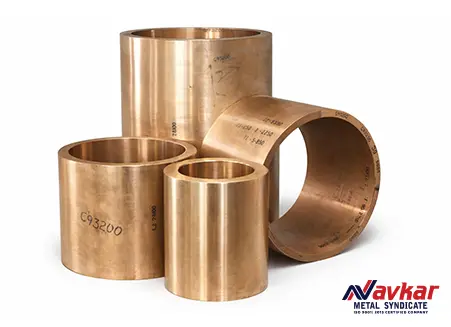
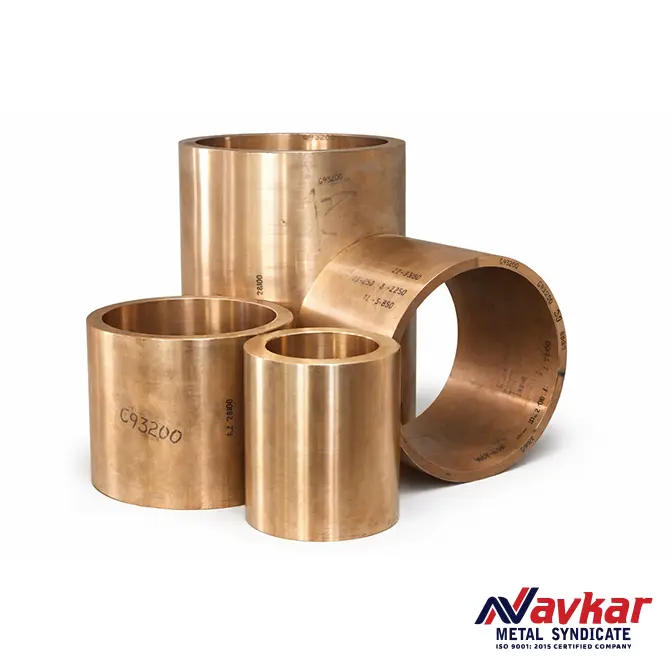
C93200 High Leaded Tin Bronze (SAE 660)

Our Products
Our Brochure
C93200 High Leaded Tin Bronze (SAE 660) Brochure
Download

Descriptions
C93200 High Leaded Tin Bronze, also known as SAE 660 Bronze, is one of the most widely used bearing and general-purpose bronze alloys. It combines excellent machinability, wear resistance, and anti-seizing properties with the ability to withstand moderate loads and speeds. The alloy contains a balanced composition of copper, tin, lead, and zinc, which gives it a unique combination of strength, lubricity, and fatigue resistance.
C93200 offers outstanding embedability and conformability, allowing it to absorb small dirt particles or misalignments without damage — a key reason it’s preferred for bushings, bearings, thrust washers, and pump components. It performs well in applications where lubrication may be marginal or intermittent.
This bronze alloy’s excellent machinability (around 70–80% of free-cutting brass), coupled with its good casting characteristics and wear resistance, makes it one of the most versatile bronzes used in industrial and automotive applications worldwide.
Chemical Composition
The typical chemical composition of C93200 High Leaded Tin Bronze (SAE 660) is shown below. This balanced blend of copper, tin, lead, and zinc delivers an excellent combination of strength, wear resistance, and lubricity, making the alloy ideal for high-duty bearing and bushing applications.
| Element | Percentage (%) | Function / Remarks |
|---|---|---|
| Copper (Cu) | 81.0 – 86.0 | Base metal providing strength, ductility, and corrosion resistance |
| Tin (Sn) | 7.0 – 10.0 | Increases hardness, tensile strength, and resistance to corrosion and fatigue |
| Lead (Pb) | 7.0 – 10.0 | Acts as a natural lubricant, improving machinability and anti-friction behavior |
| Zinc (Zn) | Balance | Improves casting quality and provides solid-solution strengthening |
| Others (Fe, Ni, Sb, etc.) | ≤ 1.0 | Trace elements to refine grain structure and mechanical stability |
Note: Copper plus all named alloying elements total ≥ 99.5%. Minor variations may occur depending on specific manufacturing standards and product forms.
Mechanical, Physical & Fabrication Properties
At room temperature, C93200 High Leaded Tin Bronze (SAE 660) exhibits an excellent balance of strength, ductility, and wear resistance. These mechanical properties make it ideal for bushings, bearings, thrust washers, and wear plates where anti-friction and durability are critical.
| Mechanical Properties | ||
|---|---|---|
| Property | Typical Value | Remarks |
| Tensile Strength | 240 MPa (34,800 psi) | Good strength for moderate load-bearing applications |
| Yield Strength | 125 MPa (18,100 psi) | Excellent flexibility and dimensional stability under stress |
| Elongation at Break | 20% | Good ductility for machining and forming operations |
| Brinell Hardness | 65 HB | Provides good surface wear resistance |
| Compressive Strength | 315 MPa (45,700 psi) | Excellent bearing strength under static load |
| Fatigue Strength | 110 MPa (16,000 psi) | Ensures long-term reliability under cyclic stress |
| Machinability Rating | 70 (vs. Free-Cutting Brass = 100) | Excellent machinability for precision components |
| Physical Properties | ||
|---|---|---|
| Property | Typical Value | Remarks |
| Density | 8.91 g/cm³ | High density ensures vibration resistance and stability |
| Electrical Conductivity | 12% IACS | Moderate electrical performance for static components |
| Thermal Conductivity | 58.2 W/m·K | Good heat dissipation for bearing and sliding applications |
| Coefficient of Thermal Expansion | 17.3 × 10⁻⁶ /°C | Stable dimensional performance across temperature variations |
| Melting Point (Solidus) | 854°C (1,570°F) | Beginning of melting range |
| Melting Point (Liquidus) | 977°C (1,790°F) | Complete melt point for casting applications |
The combination of high compressive strength, good fatigue resistance, and superior machinability makes C93200 Bronze a trusted material in hydraulic systems, automotive bearings, pumps, and gear assemblies.
Applications
C93200 High Leaded Tin Bronze (SAE 660) is extensively used in applications that require a combination of wear resistance, excellent machinability, and moderate strength. Its self-lubricating nature and ability to operate under marginal lubrication make it one of the most versatile bearing alloys in industry.
- Bearings & Bushings: Ideal for moderate-load and moderate-speed applications where resistance to wear and seizure is critical.
- Machine Tool Components: Commonly used for thrust washers, wear plates, guide sleeves, and spacers in precision machinery.
- Automotive Components: Applied in bushings, washers, connecting linkages, and sliding assemblies for reliable long-term performance.
- Marine Applications: Excellent corrosion resistance in seawater, brine, and industrial fluids makes it suitable for ship parts, propeller bushings, and pump bearings.
- Industrial Equipment: Used in pumps, compressors, turbines, and heavy-duty mechanical systems where machinability and wear life are essential.
The alloy’s lead content provides inherent lubrication, reducing friction and wear to ensure longer service life, smoother operation, and consistent performance in both rotating and sliding assemblies.
Standards & International Equivalents:
C93200 High Leaded Tin Bronze (SAE 660) complies with several international material standards covering cast, wrought, and bearing-grade bronzes. These standards ensure consistency in composition, mechanical strength, and performance characteristics across various industrial applications.
| Standard Organization | Designation | Description / Remarks |
|---|---|---|
| UNS | C93200 | Unified Numbering System designation for High Leaded Tin Bronze |
| ASTM | B271, B505, B584 | Standards covering cast copper-base alloys, continuous castings, and sand castings |
| SAE | J461, J463, J660 | Specifications for bearing and bushing bronze materials used in automotive and mechanical applications |
| DIN | 2.1090.03 | German equivalent designation for tin–lead bronze |
| BS | BS 1010 | British Standard equivalent for High Leaded Tin Bronze |
| Indian Standard (IS) | No direct IS equivalent | Similar alloys are used for bearing and bushing applications in India |
These global standards ensure C93200 Bronze meets performance expectations for industrial, marine, and mechanical engineering components requiring reliability and wear resistance.
Common Names & International Identifiers
C93200 High Leaded Tin Bronze is recognized internationally under a variety of commercial and standard designations. These references are widely used by manufacturers, suppliers, and engineers to ensure correct alloy selection and specification across different markets and standards.
| Category | Designation / Name | Remarks |
|---|---|---|
| Common Names | SAE 660, High Leaded Tin Bronze | Most popular bearing bronze alloy; excellent machinability and wear resistance |
| Trade Designations | UNS C93200, SAE J461, SAE J463, SAE J660 | International and automotive specifications for bearing-grade bronze |
| CDA Alloy Number | 932 | Assigned by the Copper Development Association (CDA) |
These designations ensure consistent identification and traceability of C93200 Bronze across industrial, marine, and mechanical engineering applications.
Common Product Forms & Dimensions
Material: Leaded Tin Bronze (C93200)
Availability: Supplied in semi-finished, mill stock, or near-net forms suitable for
bushings, bearings, washers, gears, and machined components.
| Product Form | Outer Diameter / Size Range | Standard Length | Remarks |
|---|---|---|---|
| Solid Bars / Rounds | 3/8” to 13” O.D. | 105” (Custom lengths available) | Used for bushings, bearings, and machined parts |
| Tubes / Hollows | 1” to 16” O.D. | 105” (Custom lengths upon request) | Contact us for specific wall thickness requirements |
| Rectangles / Flats | Up to 20” width | 105” (Standard) | For wear plates, guide strips, and custom machined profiles |
| Custom Profiles & Sections | As per customer drawings | Custom | Available in hex, square, plate, billet, bloom, or structural shapes |
Shape/Form: Available in anode, bar stock, billet/bloom, squares, hex, plate, profile, flats, or structural sections to meet diverse engineering and manufacturing requirements.
Tell Us What You Need
30+
Years of Experience
Trusted Worldwide | Supplying Copper & Alloys to 1000+ clients
We usually respond within 24 working hours.